
Planning a trip across Asia in 2026? Then you've probably already realised that staying connected whilst hopping between countries can be a proper headache. Between swapping physical SIM cards, dealing with roaming charges, and hunting down local shops in unfamiliar cities, it's enough to make you want to just switch off entirely. That's where finding the best eSIM for Asia travel becomes absolutely crucial. Whether you're island-hopping in Thailand, exploring temples in Japan, or navigating the bustling streets of Singapore, having reliable mobile data without the hassle of traditional SIM cards can transform your entire travel experience.
Why eSIMs Have Become Essential for Asian Travel
Remember the days of arriving at an airport, exhausted from your flight, and immediately queuing for a local SIM card? Those days are rapidly becoming ancient history. The best eSIM for Asia travel eliminates all that stress with instant digital activation.
Asia presents unique connectivity challenges that make eSIMs particularly valuable. You're often crossing multiple borders in a single trip, each with different network providers and pricing structures. Traditional roaming fees can spiral out of control, especially if you're visiting countries like Japan or Singapore where data usage adds up quickly.
The Coverage Question
When evaluating the best eSIM for Asia travel, coverage is absolutely paramount. Asia isn't a monolithic region. What works brilliantly in Tokyo might leave you stranded in rural Vietnam. The continent spans incredibly diverse infrastructure, from South Korea's ultra-fast 5G networks to more patchy coverage in remote areas of Indonesia.
Most quality eSIM providers now offer regional plans that cover multiple Asian countries, but the devil's in the details. You'll want to check:
- Which specific countries are included in "Asia" packages
- Whether major cities and tourist areas have 4G/5G coverage
- If rural or remote destinations you're visiting are properly supported
- Network partnerships and which local carriers they use

Comparing Top eSIM Providers for Asian Destinations
The eSIM market has exploded in 2026, which means more choices but also more confusion. Let's break down what actually matters when you're selecting the best eSIM for Asia travel.
Data Plans and Pricing Structures
Not all data plans are created equal. Some providers offer unlimited data but throttle your speeds after a certain threshold. Others give you a fixed amount of high-speed data that's more suitable for navigation and messaging rather than streaming videos.
| Plan Type | Best For | Typical Price Range | Considerations |
|---|---|---|---|
| Daily unlimited | Heavy data users, digital nomads | £5-8 per day | Check throttling policies |
| Fixed data bundles | Casual travellers | £15-40 for 5-20GB | Better value for moderate use |
| Regional multi-country | Multi-destination trips | £30-60 for 10-30GB | Verify all countries included |
| Country-specific | Single-destination stays | £10-25 per week | Often best speeds |
The pricing landscape has become more competitive in 2026, which is brilliant news for travellers. However, don't just chase the cheapest option. I've learned the hard way that a slightly more expensive plan with reliable coverage beats a budget option that drops out constantly.
Activation Speed and Setup Process
One massive advantage of choosing the best eSIM for Asia travel is the speed of activation. Most providers now offer instant QR code delivery, meaning you can be connected within minutes of purchase. This is particularly valuable when you've just landed after a long-haul flight and need immediate access to maps, messaging, or ride-sharing apps.
The installation process typically involves:
- Purchasing your plan online before or during your trip
- Receiving a QR code via email
- Scanning the code through your device settings
- Activating the eSIM when you arrive in-country
Some devices make this process even smoother. If you're using an iPhone, you'll find that eSIM activation on newer models is remarkably straightforward, with clear prompts guiding you through each step.
Essential Features to Look For
Beyond basic connectivity, the best eSIM for Asia travel should offer features that genuinely enhance your travel experience. Let's explore what separates the exceptional from the merely adequate.
Multi-Device Compatibility
Travelling with multiple devices? Perhaps you've got a phone and a tablet, or you're travelling with family members who each need connectivity. The ability to manage multiple eSIM installations from a single account can save significant money and hassle.
Check whether your provider supports:
- Multiple eSIM profiles on a single device
- Easy switching between different regional plans
- Top-ups without requiring new QR codes
- Sharing data across devices
Customer Support When You Need It
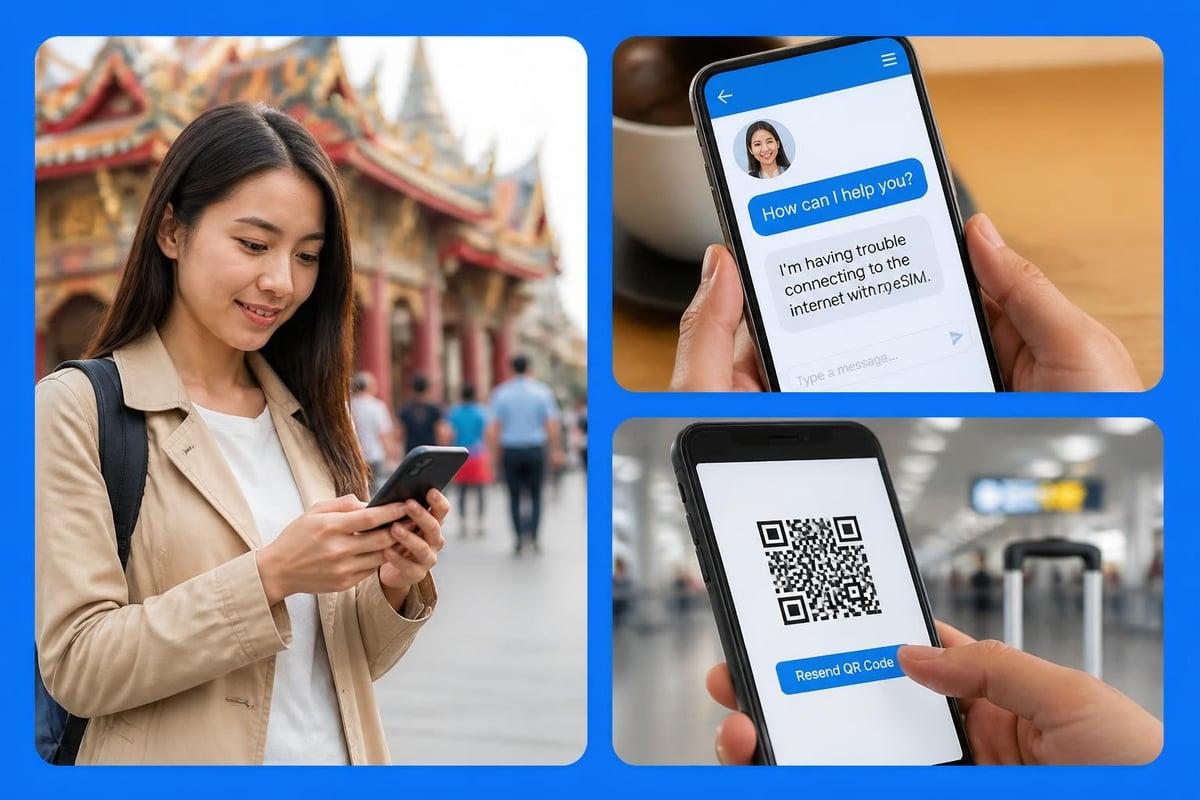
Here's something travellers often overlook until they desperately need it: customer support. When you're standing on a street corner in Bangkok at midnight and your data suddenly stops working, you want responsive help, not an automated chatbot that doesn't understand your problem.
Look for providers offering 24/7 support through multiple channels. WhatsApp support has become particularly valuable, as you can reach out using WiFi even when your primary data connection fails.
Country-Specific Considerations Across Asia
Asia's incredible diversity means that the best eSIM for Asia travel needs to adapt to vastly different environments. Let's examine key considerations for major destinations.
Japan's Network Landscape
Japan presents unique connectivity challenges despite having excellent infrastructure. The country's networks are highly advanced, but SIM registration requirements have historically been strict. eSIMs bypass much of this complexity, offering instant access to NTT Docomo, SoftBank, or KDDI networks.
For travellers visiting Japan specifically, unlimited data plans are popular because the country's incredible public transport system encourages constant connectivity for navigation and translation apps. Speed matters here too, as Japan's infrastructure supports incredibly fast 5G in major cities.
Southeast Asian Connectivity
Countries like Thailand, Vietnam, and Indonesia each have distinct network characteristics. Thailand's tourist areas generally have excellent coverage, but venture into northern provinces and you'll notice significant variations in speed and reliability.
Indonesia's archipelago nature creates particular challenges. An eSIM that works brilliantly in Bali might struggle in more remote islands. Always check specific coverage maps for islands you're visiting, not just the country as a whole.
Singapore and Malaysia
These neighbouring countries often appear together in regional packages, which makes sense given their proximity and the frequency of cross-border travel. Singapore's compact size means near-perfect coverage everywhere, whilst Malaysia's coverage varies more significantly between Kuala Lumpur and rural areas of Sabah or Sarawak.
Regional vs Country-Specific Plans
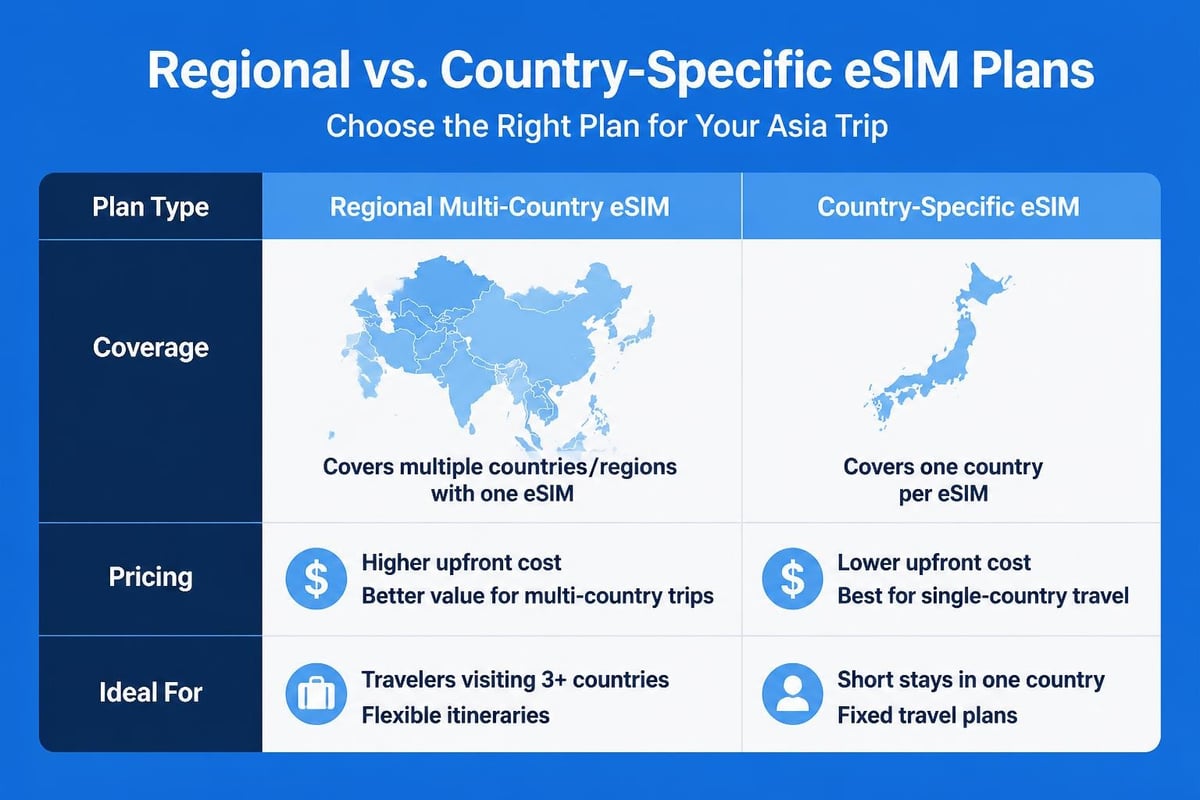
This might be the biggest decision you'll make when selecting the best eSIM for Asia travel. Should you opt for a regional plan covering multiple countries, or purchase individual country-specific plans as you go?
When Regional Plans Make Sense
Regional plans shine when you're hopping between countries frequently. If your itinerary includes Japan, South Korea, Thailand, and Vietnam within a two-week period, constantly switching between country-specific plans becomes tedious and potentially more expensive.
Benefits of regional plans include:
- Seamless connectivity when crossing borders
- Often better value for multi-country trips
- Single purchase and setup process
- Flexibility to change your route without buying new plans
However, comprehensive guides comparing regional options highlight that regional plans sometimes offer slower speeds than country-specific alternatives because they use roaming agreements rather than direct network access.
The Country-Specific Advantage
If you're spending significant time in one destination, country-specific plans often deliver superior performance. You'll typically get:
- Direct access to the best local networks
- Potentially faster speeds and better coverage
- More competitive pricing for longer stays
- Plans tailored to that country's specific usage patterns
For travellers spending weeks in countries like South Korea or the Philippines, this approach often makes more financial sense.
What Makes an eSIM Provider Stand Out in 2026
The market has matured significantly, and travellers have become more discerning. The best eSIM for Asia travel in 2026 needs to deliver on multiple fronts beyond just basic connectivity.
Transparent Pricing Without Hidden Fees
Nothing's more frustrating than discovering unexpected charges after you've already committed to a provider. Top-tier eSIM services now offer completely transparent pricing with no roaming fees, no activation charges, and clear data policies.
Watch out for providers that advertise low base prices but then charge extra for:
- QR code delivery
- Multiple device installations
- Customer support access
- Activation in specific countries
The best providers include everything in their upfront pricing, making it easy to budget your connectivity costs alongside accommodation and activities.
Speed and Network Quality
Not all eSIM connections are equal in terms of performance. Some providers prioritise their traffic lower than native SIM card users, resulting in slower speeds during peak times. Reviews and comparisons can reveal which providers consistently deliver high-quality connections.
| Performance Metric | Excellent | Acceptable | Poor |
|---|---|---|---|
| Download speeds (urban) | 50+ Mbps | 10-50 Mbps | <10 Mbps |
| Latency | <50ms | 50-100ms | >100ms |
| Video streaming quality | 1080p smooth | 720p occasional buffering | 480p frequent buffering |
| Connection stability | 99%+ uptime | 95-99% uptime | <95% uptime |
Flexibility and Top-Up Options
Your data needs might change during your trip. Perhaps you initially bought 10GB thinking that would suffice, but you've discovered amazing photography opportunities and want to upload more content. The ability to top up quickly without purchasing an entirely new plan is incredibly valuable.
Look for providers that offer:
- In-app top-ups that activate immediately
- Prorated pricing for additional data
- Extended validity periods without data increases
- Plan upgrades without losing existing credit
Making Your eSIM Work Harder
Once you've selected the best eSIM for Asia travel, a few smart practices can maximise its value and ensure reliable connectivity throughout your journey.
Device Compatibility Checks
Before you depart, verify that your device properly supports eSIM technology. Whilst most phones from 2020 onwards include eSIM capability, there are exceptions. Check your device's compatibility well in advance, as discovering incompatibility at the airport is a nightmare scenario.
Your device needs to be carrier-unlocked to use an eSIM from a different provider. Contact your home carrier before travelling if you're uncertain about your phone's lock status.
Managing Multiple Profiles
Modern smartphones can store multiple eSIM profiles simultaneously, even if they can only use one for data at a time. This feature becomes incredibly useful when travelling across Asia. You might keep your home number active for important calls whilst using your travel eSIM for data.
Here's how to optimise your setup:
- Install your travel eSIM before departure whilst connected to WiFi
- Set your home SIM as primary for calls/SMS
- Designate your travel eSIM as the data line
- Enable WiFi calling on your home number where available
- Switch between profiles in settings as needed
Data Conservation Strategies
Even with generous data allowances, smart usage habits can extend your plan's value. Background app refresh, automatic updates, and cloud photo backups can consume data rapidly without you realising it.
Consider these conservation techniques:
- Disable automatic app updates until you're on WiFi
- Use offline maps downloaded in advance
- Adjust streaming quality settings to standard definition
- Enable data saver modes in your device settings
- Download content for offline viewing before leaving accommodation
Security Considerations for eSIM Users
Cybersecurity shouldn't take a holiday just because you are. Using the best eSIM for Asia travel actually offers some security advantages over public WiFi, but you still need to maintain good digital hygiene.
VPN Usage with eSIMs
Virtual Private Networks add an encryption layer that protects your data from interception. Some countries in Asia have restrictions or monitoring on internet usage, making VPN usage not just advisable but sometimes essential for accessing certain services.
However, VPNs can impact your data consumption significantly. Encryption overhead typically increases data usage by 10-20%, so factor this into your plan selection. Test your VPN before travelling to ensure compatibility with your eSIM provider.
Avoiding Common Scams
eSIM QR codes are valuable. Treat them like cash. Never share your QR code publicly or with unauthorised parties. Scammers have been known to pose as customer support agents requesting QR codes to "verify" accounts.
Legitimate providers will never ask you to:
- Share your QR code via email or messaging
- Provide payment information through unsecured channels
- Install third-party apps to "optimise" your connection
- Pay additional fees after initial purchase (except for voluntary top-ups)
Real-World Performance Across Popular Routes
Theory is useful, but how do eSIMs actually perform on common Asian travel routes? Let's examine practical scenarios based on the most popular 2026 itineraries.
The Southeast Asia Circuit
Many travellers follow a route through Thailand, Vietnam, Cambodia, and Laos. This circuit presents interesting challenges because infrastructure quality varies dramatically between countries. Bangkok and Ho Chi Minh City offer excellent connectivity, whilst rural Cambodia and northern Laos can be patchy regardless of your provider.
For this route, regional eSIM comparisons suggest that multi-country plans perform better than constantly switching between country-specific options, primarily because border crossings happen frequently and sometimes unexpectedly.
The Northeast Asia Technology Trail
If you're visiting Japan, South Korea, and Taiwan, you're travelling through some of the world's most connected countries. Here, the best eSIM for Asia travel should prioritise speed and reliability over basic coverage, as infrastructure is universally excellent in urban areas.
Unlimited data plans become particularly attractive on this route because these countries encourage digital integration in daily life. Everything from restaurant menus to transport ticketing often assumes constant connectivity.
The Island-Hopping Adventure
Travelling through Indonesia, the Philippines, or island regions of Thailand requires careful provider selection. Coverage maps need examination at the island level, not just the national level. An eSIM that works perfectly in Manila might struggle in Palawan, whilst Bali coverage doesn't guarantee connectivity in Sumba.
For island-hopping itineraries, consider whether your provider offers detailed coverage maps showing specific islands and regions rather than just country-wide availability.
Budget Planning for eSIM Costs
Let's talk numbers. How much should you budget for the best eSIM for Asia travel, and how does this compare to traditional roaming or local SIM cards?
Cost Comparison Analysis
For a typical two-week Asian trip visiting three countries, here's how costs typically compare in 2026:
| Option | Estimated Cost | Convenience | Coverage Quality |
|---|---|---|---|
| Home carrier roaming | £120-200 | Excellent | Varies |
| Local SIM cards (×3) | £30-60 | Poor | Excellent per country |
| Regional eSIM plan | £35-55 | Excellent | Very good |
| Country-specific eSIMs | £40-70 | Good | Excellent |
The eSIM sweet spot offers the best balance of convenience, cost, and quality. You're paying slightly more than local SIMs but avoiding the hassle of finding shops, language barriers, and the risk of overpaying tourist-targeted SIM vendors.
Hidden Value in eSIM Convenience
Pure price comparisons don't capture the full value proposition. Consider the time saved not hunting for SIM card shops, the stress avoided when arriving late at night, and the seamless experience of staying connected across borders. For many travellers, these convenience factors justify any marginal price difference.
Additionally, eSIMs eliminate the risk of losing or damaging physical SIM cards, and you never face the situation of misplacing your original home SIM card during your travels.
Future-Proofing Your Asian Connectivity
The eSIM landscape continues evolving rapidly. What should you consider when selecting the best eSIM for Asia travel to ensure your choice remains relevant throughout your trip and beyond?
Emerging Network Technologies
5G deployment across Asia is accelerating dramatically in 2026. Countries like South Korea, Japan, and Singapore offer widespread 5G access, whilst others are expanding coverage in major cities. If your device supports 5G, ensuring your eSIM provider offers 5G access in supported countries can significantly enhance your experience.
However, 5G consumes more battery power and isn't always necessary for typical travel usage patterns. For navigation, messaging, and occasional browsing, 4G remains perfectly adequate and more power-efficient.
Provider Ecosystem Benefits
Some eSIM providers are building broader travel ecosystems beyond just connectivity. These might include travel insurance integration, loyalty programmes with accumulating credits, or partnerships offering discounts on accommodation and activities.
Whilst these shouldn't be your primary selection criteria, they can add meaningful value if you're choosing between otherwise comparable providers. Regular travellers particularly benefit from loyalty programmes that reduce costs on future trips.
Finding the best eSIM for Asia travel ultimately comes down to matching your specific itinerary, usage patterns, and budget with the right provider and plan structure. Whether you're embarking on a multi-country adventure or focusing on a single destination, eSIM technology has transformed Asian travel connectivity from a constant headache into a seamless experience. Ready to eliminate roaming fees and enjoy instant activation across your Asian journey? Explore gosimless.app for affordable, flexible eSIM plans covering 200+ countries with secure setup and multi-device support that keeps you connected wherever your travels take you.
gosimless Team
The gosimless editorial desk — testing eSIMs, carriers and travel connectivity so you don't have to. Updated continuously from the road.