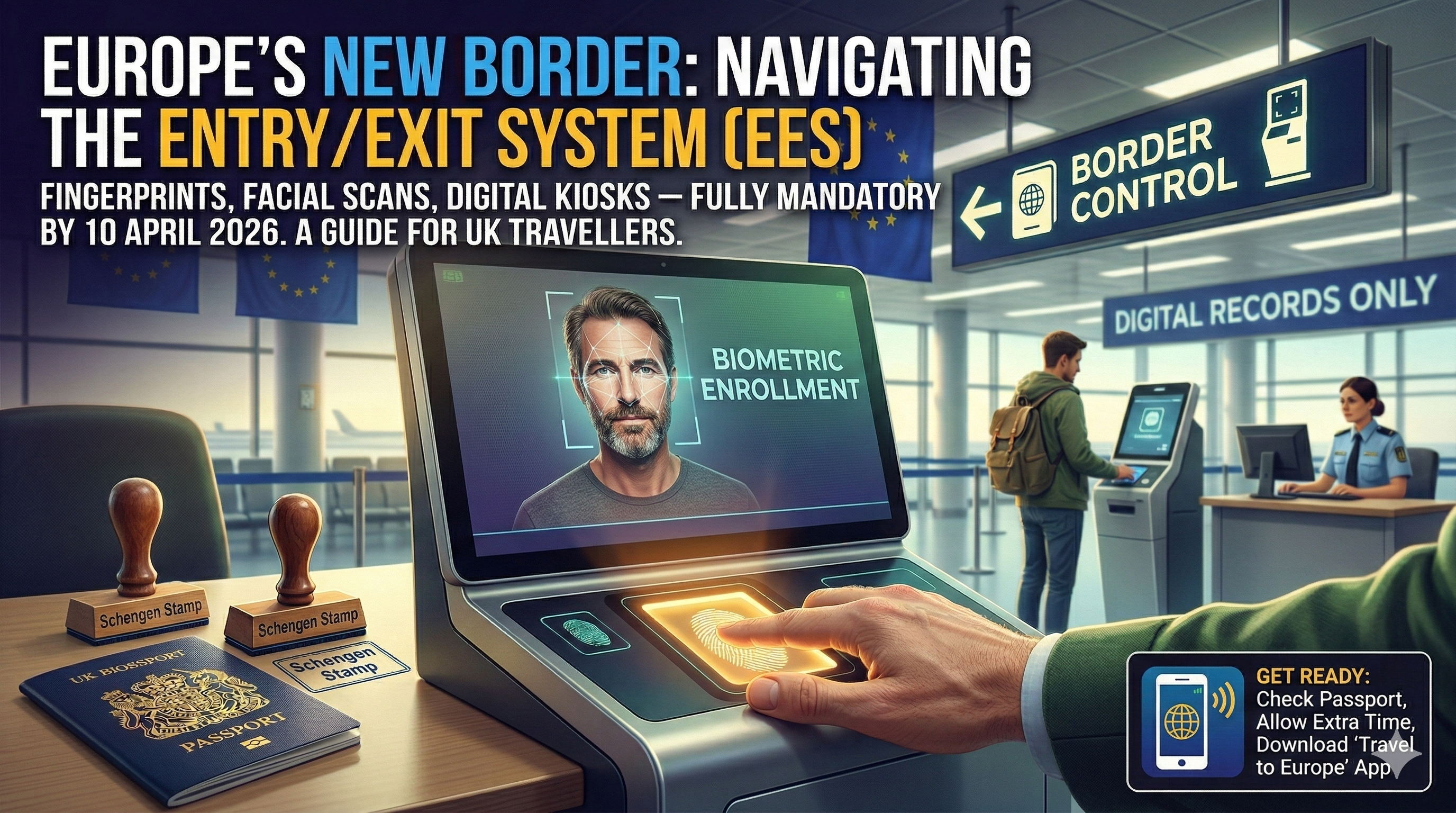
If you've travelled to Europe since October 2025, you may have already experienced something new at passport control — fingerprint scanners, facial recognition cameras, and digital kiosks replacing the familiar thud of a passport stamp. If you haven't been yet, you'll want to read this before you go.
The EU's Entry/Exit System (EES) is now well into its rollout across 29 European countries, and it will become fully mandatory on 10 April 2026. For UK travellers, this represents the biggest change to European border procedures since Brexit. Here's what it means, how it works, and what you need to do.
Stay connected from the moment you land: Having mobile data when you arrive in Europe makes everything easier — from pulling up hotel confirmations to checking the latest border guidance on your phone. A gosimless eSIM gets you online instantly, with no SIM swapping and no roaming surprises. It's one less thing to worry about at the border.
What Is the Entry/Exit System?
The EES is a digital border management system that tracks when non-EU nationals enter and leave the Schengen Area. It applies to anyone visiting for a short stay — that's trips of up to 90 days within any 180-day period — and it covers tourists, business travellers, and anyone else who isn't an EU or Schengen-area citizen.
In practical terms, the system does three things:
It replaces passport stamps with digital records. Instead of a border officer inking your passport, the system electronically logs the date, time, and location of every entry and exit. This creates a precise digital trail of your movements across the Schengen zone.
It collects biometric data. On your first visit under the new system, you'll have your fingerprints scanned and a photograph of your face captured. This biometric profile is stored and used to verify your identity on future trips.
It enforces the 90/180-day rule automatically. The system calculates exactly how long you've spent in the Schengen Area and flags anyone who overstays. No more relying on border officers to manually count passport stamps.
The whole thing is managed by eu-LISA, the EU's IT agency for large-scale information systems, and it's been years in the making — originally scheduled for 2022, then delayed repeatedly before finally launching on 12 October 2025.
Where Does the EES Apply?
The system covers 29 countries — essentially the Schengen Area. This includes most of mainland Europe plus a few non-EU members:
Austria, Belgium, Bulgaria, Croatia, Czech Republic, Denmark, Estonia, Finland, France, Germany, Greece, Hungary, Iceland, Italy, Latvia, Liechtenstein, Lithuania, Luxembourg, Malta, Netherlands, Norway, Poland, Portugal, Romania, Slovakia, Slovenia, Spain, Sweden, and Switzerland.
Two notable exceptions: Ireland and Cyprus are not part of the Schengen Area, so EES does not apply when travelling to either country. If you're heading to Dublin or Larnaca, the process at the border remains unchanged.
Is the UK Part of the EES?
No. The UK is not a member of the Schengen Area and has no involvement in running the EES. However, because UK citizens are now classified as "third-country nationals" following Brexit, British passport holders are subject to EES requirements whenever they cross into a Schengen country.
This applies equally whether you're travelling from England, Scotland, Wales, or Northern Ireland.
The Rollout Timeline: Where Are We Now?
The EES didn't switch on everywhere overnight. The European Commission designed a phased rollout to give border authorities time to adapt:
12 October 2025 — The system officially launched, with early-adopter border points beginning to collect biometric data and create digital records.
January 2026 — Half of all Schengen border points were expected to be operational, processing at least a third of passengers through the system.
March 2026 — All border points should now be running EES and collecting biometrics, processing at least half of all eligible passengers.
10 April 2026 — Full mandatory implementation. Every external Schengen border point must process every eligible passenger through EES. Passport stamping officially ends.
The rollout hasn't been entirely smooth. Some high-traffic airports experienced significant delays during the early months. Lisbon Airport suspended biometric checks temporarily after reports of lengthy queues, and the Port of Dover paused EES for car passengers during the adjustment period. France's automated e-gates (the Parafe system) have also faced compatibility challenges, with full EES integration not expected until the end of March 2026.
After April: The EU has built in a safety valve. Member states can temporarily suspend EES checks for up to 90 days after the rollout is complete, with a possible 60-day extension, specifically to manage congestion during the summer travel rush. This doesn't mean the system is delayed — it means countries can briefly ease the pressure if queues become unmanageable during peak periods.
What Happens at the Border: Step by Step
The process is designed to be relatively straightforward, though it may feel unfamiliar on your first trip. Here's what to expect.
Arrive at the border control point
Depending on the airport or port, you'll be directed to either a self-service kiosk or a staffed desk equipped with EES technology. Major hubs like Schiphol, Frankfurt, and Barcelona are investing heavily in automated kiosks. Smaller regional airports may still rely on traditional desks with EES scanners.
Have your passport scanned
Your biometric passport — the kind with a small chip symbol on the cover — is scanned electronically. The system reads the chip, pulls up your basic information, and checks whether you're already registered in the EES database.
If you don't have a biometric passport, the process can still proceed, but it may take longer and require more manual intervention. It's strongly recommended to travel with a biometric passport.
Provide your biometrics
If this is your first time going through EES, you'll need to give a full biometric registration. This involves placing four fingers on a scanner and having a photograph of your face captured by a camera at the kiosk or desk.
The whole thing takes a few minutes. It's not dramatically different from the fingerprint and photo process used at US borders, if you've experienced that.
Receive your digital entry record
That's it. Your entry is logged electronically — date, time, location — and your remaining permitted stay in the Schengen Area is calculated automatically. No stamp, no sticker, just a digital record tied to your passport and biometrics.
When you leave, the same process happens in reverse: your exit is recorded, and the system updates your travel history.
What About Repeat Visits?
This is where the system starts to show its long-term benefits. Once your biometric data is registered, subsequent trips should be noticeably faster.
Instead of going through a full registration again, the system simply verifies your identity against your stored biometrics — a quick fingerprint or facial scan — and logs your entry. If you've used e-gates at UK airports, the experience will feel similar.
There are a few things to keep in mind, though:
Your data is stored for three years. After that, you'll need to re-register on your next visit.
Renewing your passport means re-registering. Your biometrics are linked to your specific travel document. If you get a new passport between trips, you'll go through the full registration process again.
Infrastructure varies by location. The fast, automated experience works best at modern border crossings with up-to-date kiosks. Smaller or more remote border points might not have the latest equipment yet, and processing times could vary.
Will There Be Delays?
Honestly — possibly, especially in the short term. Any system of this scale takes time to bed in. During the first months, travellers have reported longer-than-usual queues at some airports as both border staff and passengers adjust to new procedures.
The European Commission has acknowledged this and built flexibility into the system, allowing temporary suspensions at busy crossings over the summer. Travel industry bodies like ABTA have also been pushing for contingency measures to prevent major disruption during peak holiday periods.
The long-term aim is the opposite of delays: faster, more efficient crossings for frequent travellers once biometric verification replaces manual checks. But getting there will require patience during the transition.
How to Prepare: A Practical Checklist
You don't need to apply for anything or pay any fees — EES registration happens at the border. But a few simple steps will make the process much smoother:
Check your passport. Make sure it's biometric (look for the small camera/chip symbol on the front cover). Most UK passports issued in recent years are biometric, but if yours is older, consider renewing before your trip.
Budget extra time. Particularly for travel between now and mid-2026, add a comfortable buffer to your airport arrival time. An extra 30–60 minutes is sensible, especially at busy hubs.
Have your documents ready. You may be asked about the purpose of your stay, your accommodation details, and your return travel. Having hotel confirmations and return tickets easily accessible on your phone will help.
Download the "Travel to Europe" app. The EU has released an official mobile app that allows you to pre-register some of your personal data before you arrive. It's available on iOS and Android and can help reduce processing time at the border.
Stay connected from arrival. Having data on your phone the moment you land means you can access boarding passes, accommodation details, and real-time border information without hunting for Wi-Fi. A gosimless eSIM activates in minutes, runs alongside your existing UK SIM, and keeps you connected across Europe with no roaming charges. Explore gosimless eSIM plans here.
Monitor official guidance. The EES is a live, evolving system. Check GOV.UK and the EU's official EES page before you travel for the latest updates.
What About ETIAS?
You may have heard about another system called ETIAS — the European Travel Information and Authorisation System. This is a separate pre-travel authorisation that will eventually require UK citizens (and other visa-exempt travellers) to apply online and pay a small fee before travelling to the Schengen Area. Think of it as Europe's version of the US ESTA.
ETIAS is not yet live. The current plan is to launch it towards the end of 2026, after EES is fully operational. When it does arrive, the two systems will work together: ETIAS will screen travellers before departure, while EES handles border processing on arrival.
For now, you don't need to worry about ETIAS. But it's worth keeping on your radar for trips later this year and beyond.
The Bottom Line
The EES represents a significant shift in how UK travellers cross European borders. The passport stamp — a staple of international travel for decades — is being replaced by fingerprints, facial scans, and digital records.
The transition won't be seamless. There will be longer queues in some places, unfamiliar technology to navigate, and inevitable teething problems as 29 countries bring a complex new system fully online. But the long-term promise is genuine: faster crossings for regular visitors, better security, and automated tracking that removes the guesswork from the 90/180-day rule.
The best thing you can do? Prepare. Check your passport, allow extra time, keep your documents accessible, and make sure you've got reliable connectivity from the moment you touch down.
A gosimless eSIM is the simplest way to stay connected across Europe — instant activation, no contracts, and reliable data on leading UK networks. Get set up before your next trip.
gosimless Team
The gosimless editorial desk — testing eSIMs, carriers and travel connectivity so you don't have to. Updated continuously from the road.