
Australia has embraced eSIM technology faster than many predicted, transforming how locals and visitors stay connected across this vast continent. Whether you're exploring Sydney's harbour, trekking through the Outback, or conducting business in Melbourne, understanding how eSIM works in Australia can save you money, time, and considerable hassle. The shift from physical SIM cards to embedded digital profiles represents more than convenience - it's reshaping the entire mobile connectivity landscape Down Under.
What Makes eSIM Australia Different in 2026
The Australian telecommunications market operates under unique conditions that make eSIM adoption particularly advantageous. With vast distances between population centres and varying coverage strengths across networks, the flexibility of eSIM technology addresses longstanding connectivity challenges.
Australia's three major networks - Telstra, Optus, and Vodafone - now offer comprehensive eSIM support alongside numerous Mobile Virtual Network Operators (MVNOs) that piggyback on these infrastructures. The competitive landscape has driven prices down whilst improving service quality, creating an ideal environment for eSIM adoption.
Coverage Across the Continent
One crucial consideration when choosing an eSIM provider in Australia involves understanding network coverage patterns. Telstra traditionally offers the most extensive regional coverage, reaching approximately 99.6% of the population, whilst Optus and Vodafone focus primarily on metropolitan and coastal areas.
Key coverage considerations include:
- Metropolitan coverage remains excellent across all three major networks
- Regional and remote areas often require Telstra's infrastructure
- Network sharing agreements are improving coverage gaps
- 5G availability now extends beyond capital cities
The ability to switch between eSIM profiles means you can maintain different providers for different purposes - perhaps a Telstra-based eSIM for regional travel and an Optus or Vodafone option for city use where competitive pricing matters more than coverage depth.
Major Carriers Offering eSIM Australia Services
Understanding which providers support eSIM technology helps you make informed decisions about connectivity options. The Australian market has matured significantly, with both established carriers and innovative newcomers offering compelling eSIM solutions.
Telstra leads in infrastructure investment but typically commands premium pricing. Their Optus mobile phone plans competitor has aggressively pursued the value segment whilst maintaining strong metropolitan coverage. Meanwhile, Vodafone mobile phone plans continue evolving their offerings with competitive international roaming features.
MVNO Options for eSIM Australia
Beyond the big three, numerous MVNOs now provide eSIM capabilities at attractive price points. These operators lease network capacity from major carriers, passing savings to consumers whilst offering identical coverage within their chosen network.
| Provider Type | Coverage Base | Typical Price Range | Best For |
|---|---|---|---|
| Telstra MVNOs | 99.6% population | $15-40/month | Regional travellers |
| Optus MVNOs | 98.5% population | $10-30/month | Urban residents |
| Vodafone MVNOs | 96% population | $10-25/month | Budget-conscious users |
Smaller providers like Tangerine mobile phone plans have carved niches by combining eSIM support with data banking and family bundling features. Similarly, Superloop mobile phone plans attract customers seeking straightforward pricing without lock-in contracts.
Setting Up Your eSIM Australia Connection
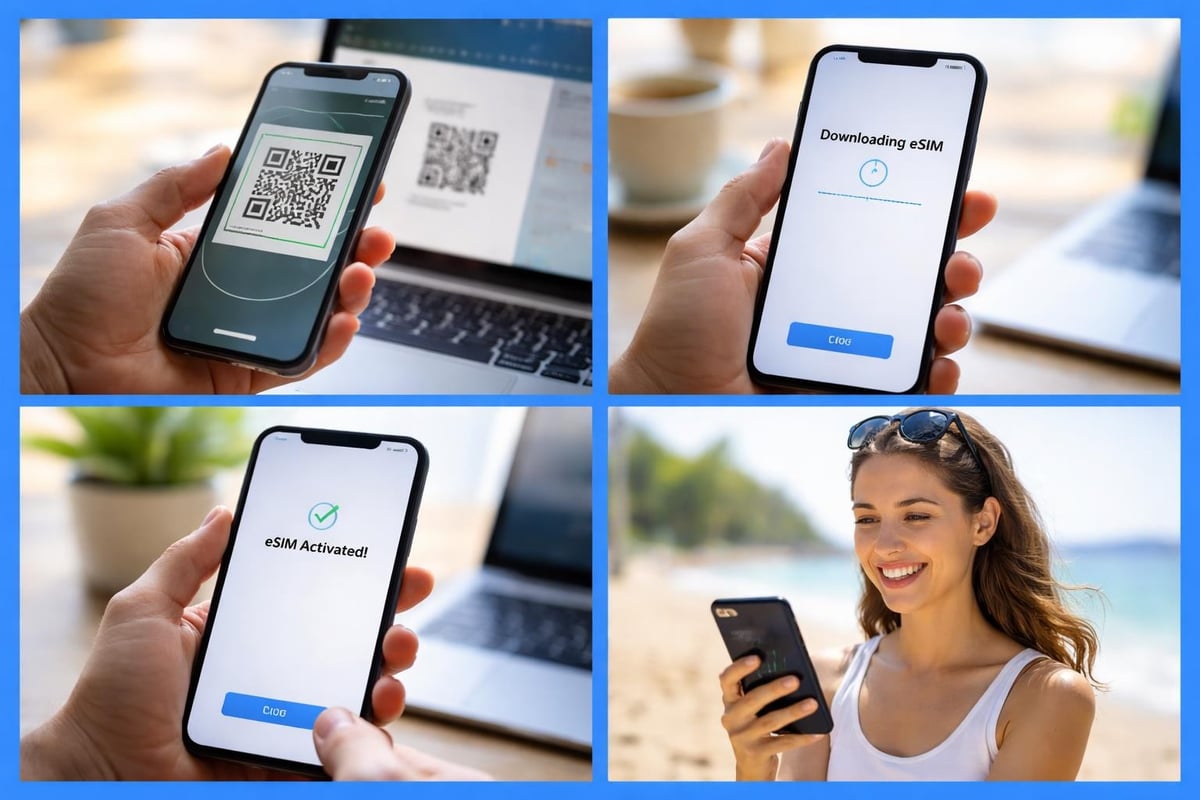
The activation process for eSIM Australia services has become remarkably straightforward, typically requiring just minutes rather than the hours or days associated with physical SIM delivery and activation.
Most providers follow a standardised activation workflow that works across different devices and operating systems. The process eliminates waiting for postal delivery, visiting retail stores, or handling tiny physical cards that inevitably get lost at inconvenient moments.
Step-by-Step Activation Process
- Verify device compatibility by checking manufacturer specifications
- Purchase your eSIM plan from your chosen provider
- Receive your QR code via email or app notification
- Access device settings and navigate to mobile/cellular options
- Scan the QR code using your device camera
- Download the eSIM profile which installs automatically
- Label your line for easy identification
- Set as default for calls, texts, or data as preferred
- Confirm activation by testing connectivity
The entire process typically completes within five to ten minutes, assuming stable internet connectivity for the initial download. Some providers offer manual entry options if QR scanning proves problematic, though this extends setup time slightly.
Device Compatibility for eSIM Australia
Not every smartphone supports eSIM technology, though the compatible device list expands continuously as manufacturers embrace the standard. Understanding which devices work with eSIM Australia providers prevents disappointment and wasted effort.
Popular compatible devices include:
- iPhone XS, XR, and all newer models (iPhone 11, 12, 13, 14, 15, 16 series)
- Samsung Galaxy S20, S21, S22, S23, S24, and corresponding Note/Fold variants
- Google Pixel 3 and all subsequent Pixel generations
- Motorola Razr (2019 onwards) and selected Edge models
- OPPO Find X3 Pro, Find X5 Pro, and newer flagship devices
- Huawei P40, P50 (global versions), and Mate series flagships
Checking compatible devices before purchasing an eSIM plan saves frustration. Compatibility extends beyond phones to include certain iPads, Apple Watches, and even some laptops, though mobile connectivity remains the primary use case.
Cost Comparison: eSIM Australia Plans
Pricing structures for eSIM Australia services vary dramatically depending on usage patterns, coverage requirements, and contract preferences. The market offers everything from budget prepaid options starting under $10 monthly to premium unlimited plans exceeding $100.
Understanding the total cost of ownership requires looking beyond headline prices to examine inclusions, exclusions, and hidden fees that might apply.
Prepaid vs Postpaid Considerations
Prepaid eSIM plans dominate the traveller segment, offering flexibility without credit checks or ongoing commitments. Postpaid options appeal to residents seeking consistent service with device payment plans and premium perks.
| Feature | Prepaid eSIM | Postpaid eSIM |
|---|---|---|
| Credit check | Not required | Usually required |
| Contract length | None | 12-36 months typical |
| Data rollover | Sometimes included | Varies by carrier |
| International roaming | Pay-per-use | Often included |
| Customer priority | Standard | Premium support |
For short-term visitors or occasional users, prepaid eSIM Australia options provide unmatched flexibility. Residents with consistent usage patterns often benefit from postpaid arrangements that bundle device upgrades and international calling.
International Roaming with eSIM Australia
One significant advantage of eSIM technology involves simplified international roaming management. Rather than purchasing local SIMs in each destination or paying exorbitant roaming fees, travellers can maintain their primary Australian number whilst adding destination-specific eSIM profiles.
This dual-SIM capability transforms international travel, allowing you to receive calls and texts on your Australian number whilst using local data rates through a secondary eSIM. The cost savings prove substantial for frequent travellers, particularly those visiting multiple countries.
Services offering Australia eSIM coverage make it equally simple for international visitors to stay connected upon arrival, with instant activation replacing airport SIM card kiosks and their inflated pricing.
Managing Multiple eSIM Profiles
Modern smartphones support storing multiple eSIM profiles simultaneously, though only one or two can remain active at any given time. This storage capacity enables pre-loading eSIMs for upcoming destinations, switching between them as you travel without repeating the activation process.
Best practices for multi-profile management:
- Label each eSIM clearly with country or purpose
- Set default lines for voice, SMS, and data separately
- Disable data roaming on inactive profiles
- Monitor which line handles iMessage/WhatsApp
- Review active subscriptions regularly to avoid surprise charges
The ability to switch between profiles takes seconds through device settings, making it practical to optimise costs by using the most appropriate eSIM for your current location or task.
eSIM Australia for Business Users
Corporate adoption of eSIM technology in Australia accelerated throughout 2024 and 2025, driven by fleet management benefits and employee flexibility. Businesses can provision eSIMs remotely, update plans centrally, and maintain better oversight of telecommunications expenses.
The elimination of physical SIM logistics reduces operational overhead whilst improving security. Lost or stolen devices can have eSIM profiles remotely deactivated without requiring physical card recovery, and employees can maintain work and personal numbers on a single device without carrying multiple phones.
Enterprise Management Platforms
Larger organisations increasingly deploy Mobile Device Management (MDM) solutions that integrate eSIM provisioning and monitoring. These platforms enable IT departments to:
- Deploy eSIM profiles over-the-air to enrolled devices
- Monitor data usage across all corporate lines
- Enforce security policies and restrict profile deletion
- Generate detailed reporting for cost allocation
- Manage international travel profiles automatically
Small businesses benefit from simplified account management through web portals that most eSIM Australia providers now offer, even if full MDM integration remains unnecessary for their scale.

Common eSIM Australia Challenges and Solutions
Despite widespread adoption, eSIM technology occasionally presents challenges that users should understand before fully committing to the transition. Most issues prove minor and easily resolved, but awareness prevents frustration.
Network lock remains a consideration for devices purchased through carrier financing. Some Australian providers lock devices to their network until contract completion, preventing eSIM activation from competing carriers. Purchasing unlocked devices outright or completing contract obligations resolves this limitation.
Troubleshooting Activation Issues
When eSIM activation fails, several common culprits typically bear responsibility:
- Inadequate internet connectivity during initial download
- Device software outdated and lacking eSIM support
- Carrier lock preventing profile installation
- Incorrect QR code or manual entry errors
- Profile conflicts with existing eSIM installations
The installation guide provided by most eSIM Australia services addresses these scenarios with specific troubleshooting steps. Customer support can regenerate QR codes if scanning problems persist, and most issues resolve within minutes once properly diagnosed.
eSIM Australia Data Speeds and Network Performance
Speed expectations for eSIM Australia services match those of physical SIM cards, as the underlying network technology remains identical. The eSIM simply provides authentication and network access through different means - the actual data transmission follows the same 4G/5G protocols.
Testing across major Australian networks shows comparable performance between eSIM and physical SIM connections, with variations attributable to network congestion, tower proximity, and device capabilities rather than SIM type.
5G Availability and Coverage
Fifth-generation mobile networks continue expanding across Australian cities and regional centres, with all major carriers investing heavily in 5G infrastructure. eSIM users access 5G networks identically to physical SIM users, provided their device supports the technology and their plan doesn't artificially restrict speed.
| Network | 5G Population Coverage | 5G Cities | Average 5G Speed |
|---|---|---|---|
| Telstra | 85% (mid-2026) | 75+ locations | 250-400 Mbps |
| Optus | 80% (mid-2026) | 60+ locations | 200-350 Mbps |
| Vodafone | 75% (mid-2026) | 55+ locations | 180-320 Mbps |
These speeds prove more than adequate for streaming, video calls, and mobile hotspot use - common scenarios where eSIM flexibility particularly shines. Regional 5G deployment continues, though metropolitan areas maintain the strongest coverage and fastest speeds.
Regulatory Environment for eSIM Australia
The Australian Communications and Media Authority (ACMA) regulates telecommunications services, including eSIM offerings, ensuring consumer protections apply regardless of SIM type. These regulations mandate certain standards around service disclosure, billing transparency, and complaint resolution.
Consumer protections require providers to clearly state plan inclusions, network coverage limitations, and contract terms before purchase. The Telecommunications Industry Ombudsman (TIO) handles disputes between customers and providers when direct resolution fails, offering free mediation services.
Understanding your rights under Australian consumer law empowers you to address issues confidently. eSIM services must meet the same quality and reliability standards as traditional mobile services, with no reduced obligations due to digital delivery.
Future Trends in eSIM Australia Adoption
Looking ahead through 2026 and beyond, several trends appear poised to accelerate eSIM Australia adoption further. Device manufacturers increasingly ship phones without physical SIM trays, following Apple's lead with iPhone 14 models in the United States market.
This hardware evolution will eventually reach Australia, making eSIM proficiency essential rather than optional. Early adopters gain familiarity with the technology before it becomes mandatory, smoothing the transition when physical SIM support eventually disappears.
Emerging developments to watch:
- eSIM-only devices becoming standard rather than exceptional
- Instant carrier switching through app-based provisioning
- IoT integration expanding eSIM beyond phones to connected devices
- Enhanced security features leveraging eSIM's cryptographic capabilities
- Simplified international roaming through carrier partnerships
The competitive landscape will likely consolidate around providers offering superior digital experiences, as the physical retail advantage diminishes. Carriers investing in seamless eSIM management platforms and affordable data plans position themselves advantageously for this shift.
Privacy and Security Considerations
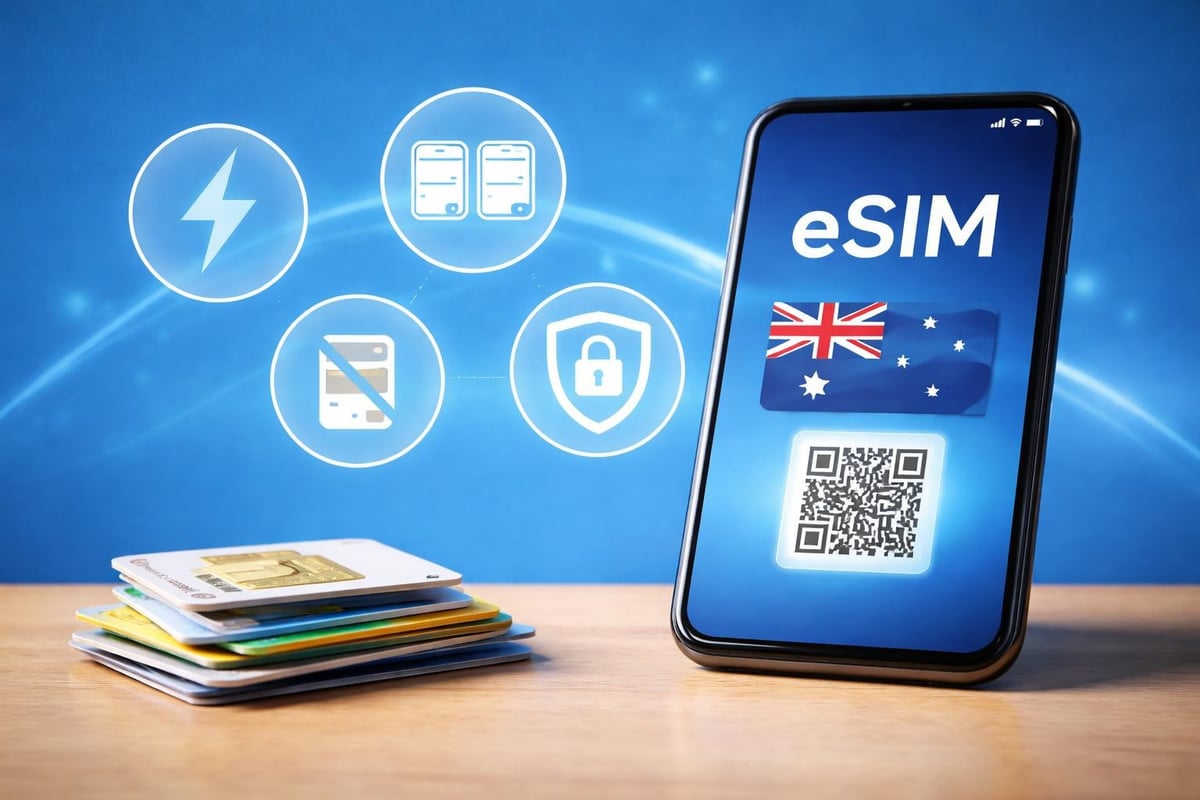
eSIM technology offers inherent security advantages over physical SIM cards, though users must still practice good digital hygiene to maximise protection. The inability to physically remove an eSIM prevents certain theft scenarios whilst introducing different security considerations.
Remote eSIM management capabilities that benefit legitimate users could theoretically assist malicious actors if account credentials become compromised. Strong passwords, two-factor authentication, and biometric locks provide essential protection layers.
Protecting Your eSIM Account
Best practices for securing eSIM Australia services include:
- Enable two-factor authentication on provider accounts
- Use unique, complex passwords for each service
- Regularly review active eSIM profiles and remove unused ones
- Be cautious of phishing attempts targeting account credentials
- Set up device lock screens with biometric authentication
- Register your IMEI with your provider for theft protection
The digital nature of eSIM makes unauthorised profile additions more difficult than physical SIM swapping, a common fraud technique. However, account security remains your primary defence against unauthorised access.
Environmental Impact of eSIM Adoption
Beyond convenience and cost benefits, eSIM Australia adoption carries environmental implications worth considering. The elimination of plastic SIM cards, their packaging, and associated logistics reduces waste and carbon emissions across the telecommunications supply chain.
Manufacturing physical SIM cards requires petroleum-based plastics, precious metals for contacts, and energy-intensive production processes. Distribution adds transportation emissions and packaging waste. Multiplied across millions of activations annually, these impacts prove substantial.
eSIM technology eliminates these material requirements entirely, delivering connectivity through software rather than hardware. Whilst device manufacturing still carries environmental costs, the marginal impact of connectivity reduces to near-zero once the phone exists.
Making the Switch to eSIM Australia
Transitioning from physical SIM to eSIM requires minimal effort for most users, particularly when staying with your current provider. Many Australian carriers now facilitate in-app conversions, transforming your existing physical SIM into an eSIM profile without changing numbers or plans.
For those switching providers whilst adopting eSIM, number portability regulations ensure you can transfer your existing number to any new carrier within one business day. The process requires providing your current account details and authorising the transfer, after which your new eSIM activates with your familiar number.
Exploring alternative affordable options helps identify competitive plans that might better suit your needs whilst making the technology transition. The combination of provider switching and eSIM adoption creates an ideal opportunity to reassess whether your current plan delivers optimal value.
eSIM Australia technology has matured into a reliable, cost-effective solution for mobile connectivity across this vast continent. Whether you're a resident seeking flexibility, a business optimising fleet management, or a traveller wanting instant connectivity, eSIM delivers tangible advantages over traditional physical cards. Ready to experience the convenience of instant activation and affordable coverage? Visit gosimless.app to explore flexible eSIM plans across 200+ countries with no roaming fees, secure payments, and multi-device support that keeps you connected wherever your journey takes you.
gosimless Team
The gosimless editorial desk — testing eSIMs, carriers and travel connectivity so you don't have to. Updated continuously from the road.