
Planning a trip across Asia and wondering how you'll stay connected without breaking the bank on roaming charges? You're not alone. In 2026, travellers are ditching traditional SIM cards and embracing eSIM technology for its convenience, flexibility, and cost savings. Whether you're island-hopping in Thailand, exploring Tokyo's neon streets, or conducting business in Singapore, finding the best eSIM for Asia can transform your travel experience from stressful to seamless. Let's dive into what makes an eSIM truly exceptional for Asian travel and which providers are leading the pack this year.
What Makes an eSIM Perfect for Asian Travel
When you're navigating multiple countries across a diverse continent like Asia, your connectivity needs aren't the same as a weekend trip to Paris. Asia presents unique challenges that the best eSIM for Asia must address head-on.
Coverage Across Multiple Countries
Asia isn't a monolith. Your eSIM needs to work seamlessly whether you're in ultra-connected Singapore or remote regions of Indonesia. The best providers offer regional plans that cover 10-20 Asian countries under a single package, eliminating the hassle of switching plans every time you cross a border.
According to TechRadar's comprehensive review, the top eSIM services for Asia prioritize broad regional coverage with consistent speeds across different networks. This matters more than you might think when you're relying on maps, translation apps, and staying in touch with loved ones back home.
- Regional flexibility: Single plan covering multiple destinations
- Network partnerships: Access to premium local carriers
- Consistent speeds: No dramatic drops when crossing borders
- Emergency connectivity: Coverage in less-traveled areas
Pricing That Actually Makes Sense
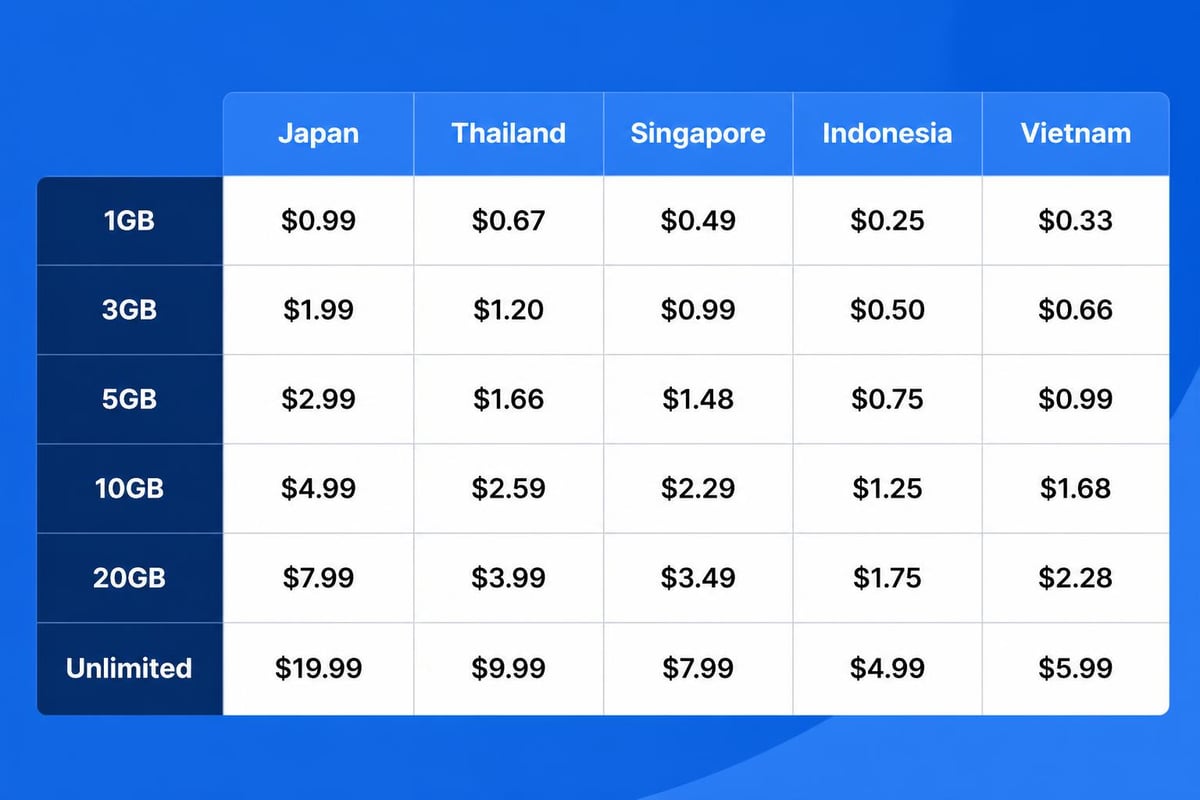
Here's something nobody tells you about Asian travel: connectivity costs vary wildly between countries. What works for Japan might be overkill for Vietnam, where data is significantly cheaper.
The best eSIM for Asia offers tiered pricing that reflects these differences. You shouldn't pay premium rates for every gigabyte when you're in countries with lower data costs.
Top eSIM Providers for Asia in 2026
Let's get specific. Which providers are actually worth your money when travelling across Asia this year?
Regional Plans vs Single-Country Options
This is where strategy matters. Are you doing a multi-country Southeast Asian adventure, or focusing deeply on one destination like Thailand?
| Provider Type | Best For | Typical Coverage | Price Range |
|---|---|---|---|
| Regional Multi-Country | Backpackers, multi-stop tours | 10-20 countries | £25-60 for 10GB |
| Single-Country Premium | Business travelers, extended stays | 1 country, extensive | £15-40 for 10GB |
| Global Plans | Round-the-world travelers | 100+ countries | £35-80 for 10GB |
| Budget Regional | Short trips, light data users | 5-8 countries | £10-25 for 3GB |
Earth SIMs tested seven providers across 12 Asian countries over five months, and their findings confirm what savvy travelers already know: there's no one-size-fits-all solution. Your perfect eSIM depends entirely on your itinerary.
What to Look for in Coverage Maps
Don't just trust the marketing materials. The best eSIM for Asia providers offer detailed coverage maps that show actual network partnerships, not just countries where they "technically" work.
Before purchasing, check:
- Which local carriers they partner with in each country
- Whether coverage extends beyond major cities
- 4G/5G availability in your specific destinations
- User reviews from recent travelers to your exact locations
- Speed test results from independent reviewers
ZetSIM's 2026 guide emphasizes the importance of understanding coverage approaches. Some providers prioritize speed in urban centers, while others focus on broader rural coverage. Neither is wrong, but one might be right for your specific journey.
Installation and Setup: Simpler Than You Think
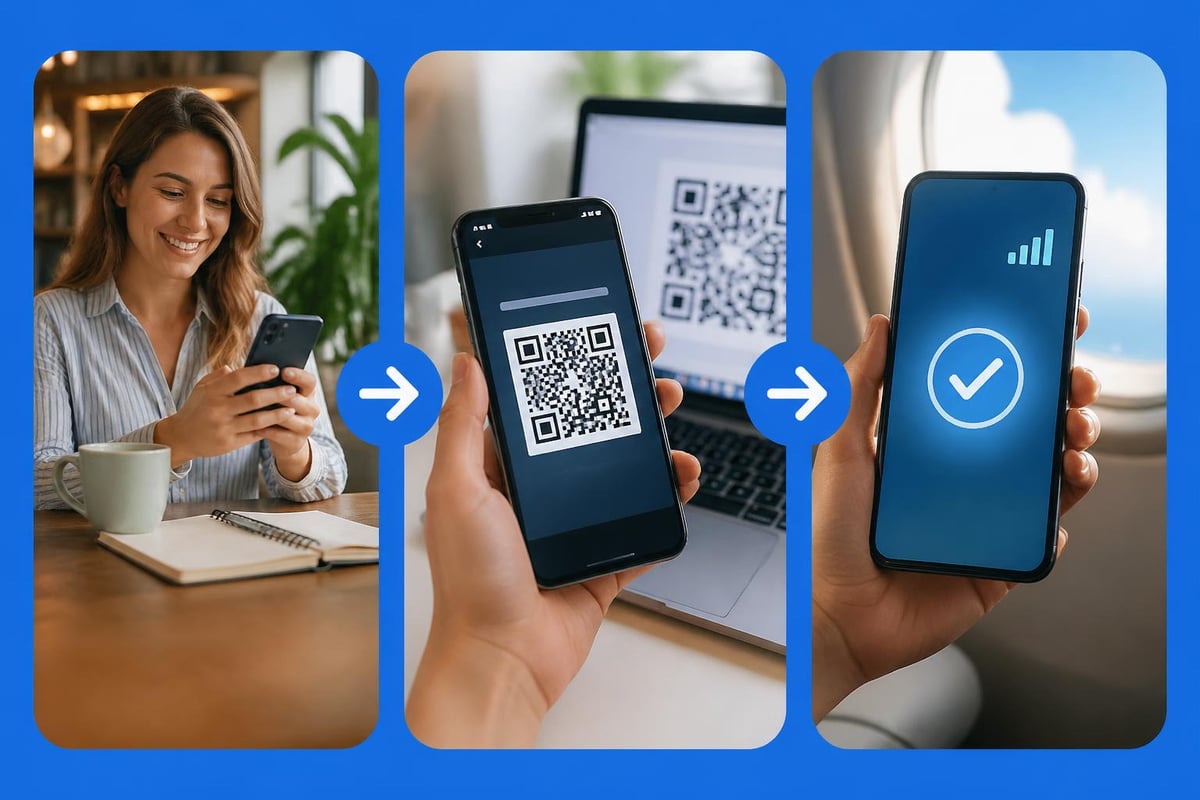
One of the biggest misconceptions about eSIM technology? That it's complicated. In reality, getting your eSIM activated takes about five minutes, and you can do it from your hotel room before your flight even lands.
The Actual Setup Process
Here's what happens when you purchase the best eSIM for Asia from a quality provider:
- Purchase your plan online through the provider's website or app
- Receive a QR code instantly via email
- Scan the QR code in your phone's settings
- Activate the plan when you're ready to use it
- Switch between eSIMs if you have multiple profiles installed
Most modern smartphones support eSIM technology, but it's worth checking compatible devices before you commit to a purchase. iPhones from XR onwards, Samsung Galaxy S20 and newer, and Google Pixel 3 and up all support eSIM functionality.
The beauty of eSIM? You can install multiple profiles and switch between them instantly. This means you could have a local Singapore eSIM for when you're in that city-state, and a broader regional plan for when you venture elsewhere.
Troubleshooting Common Issues
Even with the best eSIM for Asia, you might encounter the occasional hiccup. Here's how to solve the most common problems:
- QR code won't scan: Ensure your screen brightness is maximum and the code is centered in frame
- No service after activation: Toggle airplane mode off and on, then restart your device
- Slow speeds: Check if you've exceeded your high-speed data allowance
- Can't make calls: Most eSIMs are data-only; use WhatsApp or similar for calls
Data Allowances and Speed Considerations
How much data do you actually need for Asian travel? This traveler's guide breaks down typical usage patterns, but here's the quick version.
Realistic Data Usage Across Asia
Your data consumption varies dramatically based on how you travel. A backpacker using hostel Wi-Fi will use far less than a digital nomad working remotely from cafes.
Light users (1-2GB per week):
- Occasional maps and messaging
- Social media browsing on Wi-Fi
- Email checking throughout the day
Moderate users (3-5GB per week):
- Regular navigation and ride-sharing apps
- Social media photo uploads
- Video calls with family
- Restaurant and attraction research
Heavy users (7-10GB+ per week):
- Streaming music or podcasts
- Frequent video content consumption
- Working remotely with large file transfers
- Live streaming or vlogging
The best eSIM for Asia typically offers plans ranging from 3GB to unlimited data. For a two-week trip hitting multiple countries, most travelers find 10-15GB comfortable without feeling restricted.
Speed Expectations by Country
Not all Asian countries offer the same connectivity experience. According to GigSky's detailed comparison, you'll notice significant variations:
| Country | Average 4G Speed | 5G Availability | Urban vs Rural Gap |
|---|---|---|---|
| Singapore | 50-70 Mbps | Widespread | Minimal |
| South Korea | 45-65 Mbps | Extensive | Small |
| Japan | 40-60 Mbps | Growing | Moderate |
| Thailand | 25-40 Mbps | Major cities | Significant |
| Vietnam | 20-35 Mbps | Limited | Large |
| Indonesia | 15-30 Mbps | Very limited | Very large |
These speeds are more than adequate for typical travel needs. Even at 15 Mbps, you can stream video, navigate confidently, and stay connected without frustration.
Security and Privacy Considerations
Here's something travelers often overlook: not all eSIM providers treat your data with equal care. When you're connecting to networks across multiple countries, security becomes paramount.
What the Best Providers Do Differently
The best eSIM for Asia doesn't just connect you-it protects you. Look for providers offering:
- Encrypted data transmission across all networks
- No logging policies that actually mean something
- Secure payment processing through recognized platforms
- Two-factor authentication for account access
- Clear privacy policies written in plain English
When you're checking emails about work projects or accessing banking apps on the go, that extra layer of security isn't paranoia-it's common sense. Gizmodo's recent analysis specifically highlights security features as a key differentiator among Asian eSIM providers in 2026.
Cost Comparison: Getting the Best Value
Let's talk money. The best eSIM for Asia isn't necessarily the cheapest-it's the one offering the best value for your specific needs.
Breaking Down the True Cost
When comparing providers, don't just look at the headline price. Consider:
- Cost per gigabyte: Calculate this for fair comparisons
- Validity period: A 30-day plan you'll use for 14 days wastes money
- Top-up costs: What happens when you run out of data?
- Multi-country coverage: Could you buy cheaper single-country plans instead?
- Hidden fees: Activation charges, support fees, payment processing
For example, a £40 plan offering 20GB across 15 countries for 30 days works out to £2 per gigabyte. A £25 plan with 5GB for the same coverage is £5 per gigabyte-less headline-grabbing but actually more expensive per unit.
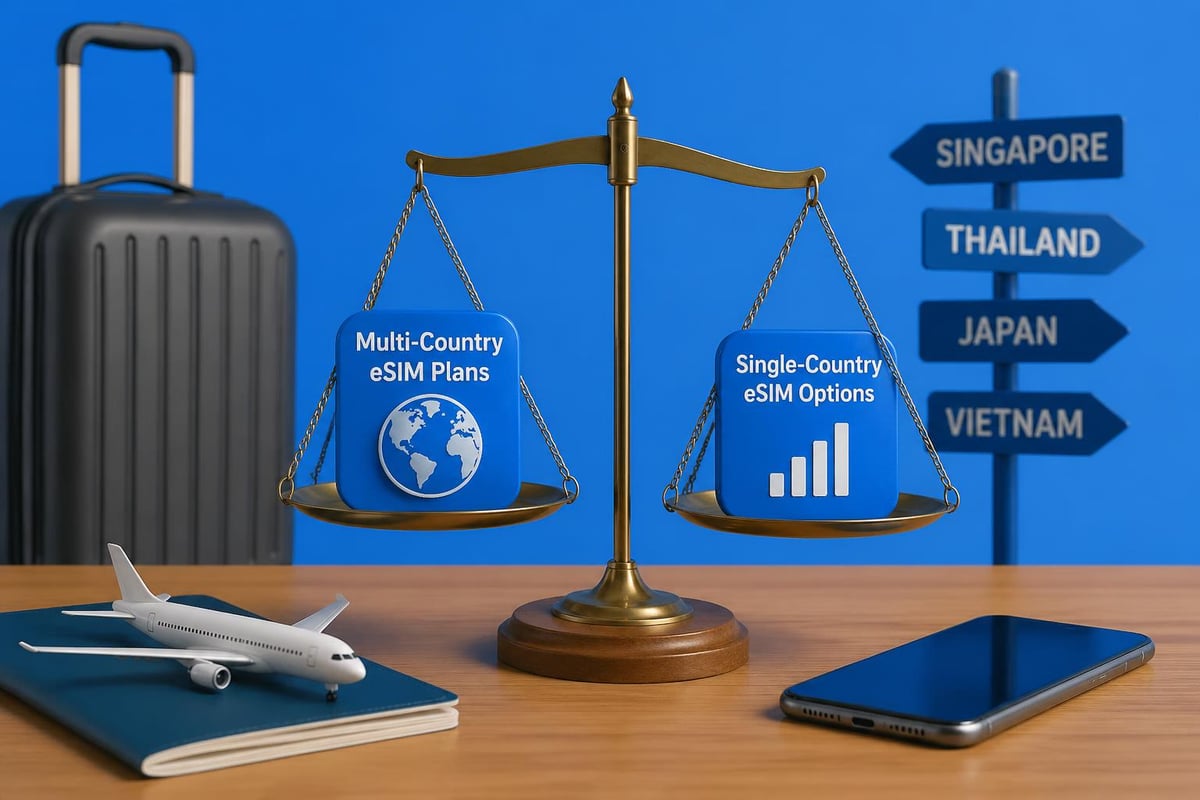
When to Buy Single-Country vs Regional Plans
This depends entirely on your itinerary. Spending two weeks in South Korea? A dedicated single-country plan will likely offer better value. Bouncing between Malaysia, Indonesia, and the Philippines in three weeks? Regional coverage makes infinitely more sense.
Asia Data Compare evaluated providers across 18 Asian countries and found that the break-even point typically occurs at three countries. If you're visiting three or more destinations, regional plans offer better value. Fewer than three? Consider individual country eSIMs.
Provider Reliability and Customer Support
Picture this: you've just landed in Bangkok, your eSIM won't activate, and you need to contact your hotel. This is when customer support stops being a nice-to-have and becomes absolutely essential.
Support Quality Across Providers
The best eSIM for Asia offers 24/7 support through multiple channels. When you're dealing with time zones spanning 12+ hours, chat support at 3 AM your time might be the only option.
Essential support features:
- Live chat with actual humans (not just bots)
- Email support with sub-24-hour response times
- Detailed FAQ and troubleshooting guides
- Installation support in multiple languages
- Active social media presence for urgent issues
eSIM City's comprehensive guide notes that customer support quality varies dramatically among providers. Some offer excellent pre-sales support but disappear once you've purchased, while others maintain consistent assistance throughout your journey.
Real User Experience Reports
Don't just trust marketing claims. Check recent reviews from travelers who've actually used the service in your specific destinations. Reddit travel communities, TripAdvisor forums, and travel Facebook groups offer unfiltered experiences that can save you significant headaches.
Special Considerations for Business Travelers
Business travel across Asia requires different priorities than backpacking. You need reliability over rock-bottom prices, and consistent speeds for video conferences over massive data allowances for streaming.
What Business Users Need
If you're traveling for work, prioritize these features:
- Premium network access: Partner networks with business-grade infrastructure
- Expense reporting: Detailed usage reports and proper invoices
- Multi-device support: Connect your laptop via hotspot without restrictions
- Guaranteed speeds: Service level agreements that actually matter
- Easy procurement: Corporate payment options and bulk purchasing
Services like those offered through gosimless.app provide instant eSIM activation with secure payments and multi-device support, making them particularly suitable for business travelers who can't afford connectivity failures during important meetings or client presentations.
The Future of eSIM in Asia
Asia leads global eSIM adoption, and 2026 has seen significant advances in coverage, speeds, and affordability. Countries like Singapore and South Korea have near-universal eSIM support, while others are rapidly catching up.
Emerging Trends Worth Watching
The best eSIM for Asia in 2026 isn't just about current performance-it's about providers investing in future infrastructure:
- 5G expansion: More providers offering 5G in major Asian cities
- IoT integration: eSIMs for travel devices beyond phones
- Dynamic pricing: AI-driven plans that adapt to your usage
- Blockchain verification: Enhanced security through distributed ledgers
- Instant plan switching: Change coverage areas mid-trip without new QR codes
These innovations mean that choosing a forward-thinking provider now sets you up for better service as technology evolves during your travels.
Making Your Final Decision
So what's the verdict? The best eSIM for Asia depends on your unique circumstances, but certain principles apply universally.
Your Decision-Making Checklist
Before you purchase, confirm:
- Coverage matches your exact itinerary
- Data allowance suits your usage patterns
- Pricing offers genuine value, not just low headline costs
- Customer reviews are recent and predominantly positive
- Support channels match your comfort level
- Activation process is straightforward and well-documented
For most travelers in 2026, the sweet spot sits with providers offering regional coverage across 10-15 countries, 10-20GB of data, 30-day validity, and responsive customer support-all for £30-50. This provides flexibility without overpaying for coverage you won't use.
Testing Before You Travel
Here's a pro tip: if possible, activate your eSIM before you leave home. Most providers let you install the profile early (it just won't connect to networks until you're in coverage areas). This lets you troubleshoot any installation issues while you still have reliable Wi-Fi and time to contact support.
You can even check your installation guide in advance, ensuring you understand the process before you're standing in an airport terminal with luggage and jet lag.
Regional Variations Worth Understanding
Not all Asian regions are created equal when it comes to connectivity. Southeast Asia operates differently from East Asia, and what works brilliantly in one area might struggle in another.
Southeast Asia Specifics
Countries like Thailand, Vietnam, and Indonesia present unique challenges. Infrastructure varies significantly between tourist areas and rural regions, and some eSIM providers maintain better partnerships in specific countries.
For Southeast Asian travel specifically, look for providers with strong local carrier relationships in each country you'll visit. A provider with excellent coverage in Thailand might have mediocre service in Vietnam, making regional plans less valuable than they initially appear.
East Asia Excellence
Japan, South Korea, and Taiwan offer world-class connectivity infrastructure. The best eSIM for Asia targeting these countries can deliver exceptional speeds and reliability, often rivaling or exceeding what you'd experience with local SIM cards.
These countries also have extensive English-language support, making troubleshooting easier if issues arise. Premium providers often allocate more resources to these markets due to higher business traveler volumes.
Finding the best eSIM for Asia transforms international travel from a connectivity nightmare into a seamless experience where you can navigate, communicate, and share moments without worrying about astronomical roaming charges or hunting for Wi-Fi. Whether you're exploring temples in Thailand, conducting business in Singapore, or island-hopping through Indonesia, the right eSIM keeps you connected on your terms. Ready to travel smarter? Explore instant eSIM activation for affordable, flexible coverage across Asia and 200+ countries worldwide-no roaming fees, no hassles, just reliable connectivity wherever your journey takes you.
gosimless Team
The gosimless editorial desk — testing eSIMs, carriers and travel connectivity so you don't have to. Updated continuously from the road.